Agency Admin Meeting
February 26, 2026
1:00 – 2:00
Via Zoom
Attendees: Carly Walker, Amanda Borta, Aundrea Braniff, Bonnie Ceniga, Brianna Rogers, Cari Hansen, Danyell Rejcek, Daphne Weller, Dominique Gardon, James Ewell, Jennifer Volem, Jeremy Carlson, Katy Alvarado, Kathy Duff, Kyle Knox, Leah Cooper, Lindsay Weiss, Leticia Simmons, Michael Kinnison, Mirtha Strugo, Monique Offset, Rebecca Murphy, Sam Gutierrez, Stasha Taylor
- Reason for Leaving standards
- Got no feedback from Agency Admins. Will post on Freshdesk
- PIT/HIC
- Sheltered Point in Time Count
- Emergency Shelter and Transitional housing info pulled from HMIS
- Housing Inventory Count
- Any project where individuals stay the night (excluding Alt shelter) – pulled from HMIS
- Unsheltered Point in Time Count
- Skipped and will be conducted in 2027 (only required every other year, same schedule as other Oregon CoCs)
- Who is counted
- Supported Services Only (not alternative Shelters) projects: clients entering from literal homelessness who have recently engaged in services will be counted on the HBNL
- Alternative Shelter projects: clients won’t be counted in the official sheltered PIT submitted to HUD, but we do make note of your clients counts in local sheltered PIT reports and they are counted on the HBNL
- Emergency and Transitional housing projects: Anyone checked into your program on the PIT night is included in the sheltered count, as well as the HBNL. We will also use this to double check inventory and report utilization for the Housing Inventory Count
- Street Outreach projects: clients will be included in the HBNL
- Rapid Rehousing, Permanent Supported Housing and LTRA projects: clients entering from literal homelessness who do not have an HMID will be counted on the HBNL. Households with an HMID will not be counted but are important for reporting inventory and utilization on the Housing Inventory Count.
- Homelessness Prevention: None of these clients you are working with are counted on the HBNL because you are working to prevent them from entering homelessness right now
- January HBNL: 2025 vs 2026
- 2026 count is decreased of 381 people. What factors might have contributed?
- Less FDAs
- Loss of Dining room and other projects
- 2026 count is decreased of 381 people. What factors might have contributed?
- Sheltered Point in Time Count
- HMIS cost sharing draft policy
- Policy Objectives
- HMIS participation from as many local projects as possible
- Quality, usable HMIS data for community use
- Provide adequate technical support for participating providers and their staff
- Minimize administrative burden for calculating and collecting cost contributions
- Agencies & Programs Impacted
- All projects that are required by their funder to participate in HMIS are expected to contribute. Most projects already contribute through Lane County pass-through or their funding sources contribute directly (CoC)
- Current funding sources who require HMIS but do not contribute: OHCS ARH, RHY, VA, SSVF, PATH
- Other state or federal funding sources may come up in future
- YEHP HMIS requirement currently on pause
- HMIS Funding Sources
- Continuum of Care (federal) HMIS Funds – Largest contribution
- Data support for CoC-funded programs
- General support for comprehensive HMIS
- Admin and/or pass-through funds from federal, state and location funds that flow through Lane County HSD
- Data support for the specific programs funded
- Lane County Funds – less availability
- Other federal funds and state funds that don’t pass through Lane County - $0
- Continuum of Care (federal) HMIS Funds – Largest contribution
- Current HMIS Project & Contribution Status
- 159 active projects as of 02/25/26
- Federal: 21 Projects, mostly PSH and RRH
- Currently pass through LC: 63 projects, mostly HP and ES
- Not contributing but grant requires HMIS: 16 projects, mostly TH
- No contributions: 59 projects, mostly supportive services Only and ES
- 159 active projects as of 02/25/26
- Changes in HMIS structure & demands
- Interest and reliance on high-quality real-time and/or monthly information rather than quarterly or annually (ex: PIT count)
- Increase in programs has increased complexity of data quality checks (more shelter and housing programs – greater potential for overlap
- Move from compliance focus to supportive technical assistance – implemented specific requests from 2021 user satisfaction survey
- Shift from output to outcome-focused reporting, sometimes with very specific guidelines that are separate from HUD’s
- HMIS Fee Options and Challenges
- Pay per user
- Security risks if license sharing, disincentivizes data use, staff time for license management (staff turnover – 595 individuals using 385 licenses in 2025)
- Pay per activity and/or issue
- Year-round billing management, discourages use of supports
- Grant percentage
- Grant awards amounts on different schedules, programs that provide significant financial assistance pay more than other programs
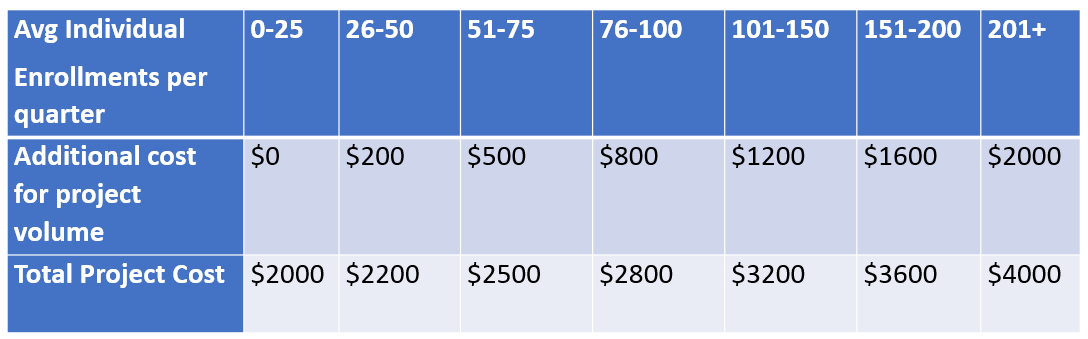
- Pay Per Project – Recommend we use
- Base charge $2000 for each project
- System admin time spent on each project: initial set up, assessment and security maintenance, inventory and grant management for federal reports
- Data quality review
- Reporting for each project
- Portion of software cost
- Additional charge based on average client enrollments/quarter
- Correlation with amount of data quality review time required and number of users support
- Base charge $2000 for each project
- Proposed Amount
- Collection Schedule & Waiver Process
- Future years: contribution collected each February
- Current projects: calculation based on previous calendar year enrollments, can submit waiver requests
- New projects: amount based on estimated individuals served
- Contribution waiver questions
- What funding sources require HMIS participation, and is HMIS an allowable cost for this grant?
- What is the program budget for this year?
- What portion of the HMIS contribution are you unable to pay?
- What is your organization’s plan for paying the HMIS contribution next year?
- Future years: contribution collected each February
- Impacted providers
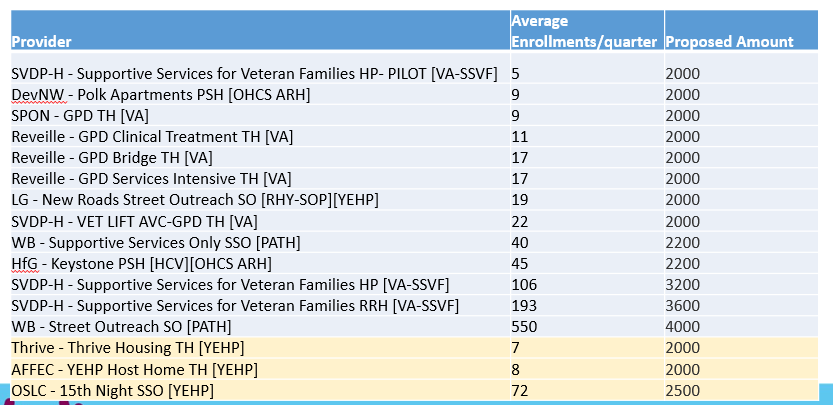
- Opened it up to feedback on the draft policy
- Pay per user
- Policy Objectives
- Next Meeting
- April in person
- If you would like to add anything to a future meeting agenda, please email Melissa (Melissa.Coloma@lanecountyor.gov)
Was this article helpful?
That’s Great!
Thank you for your feedback
Sorry! We couldn't be helpful
Thank you for your feedback
Feedback sent
We appreciate your effort and will try to fix the article